

Sir Samuel Mico’s Charities
The charity aims to provide educational grants to young people who have not reached 25 years of age, to assist them in their studies it also supports those undertaking apprenticeships.
The trusts income comes from investments from legacies left by Sir Samuel Mico, and includes rental income from the George Inn on Weymouth Quay which is owned by the trust.
The trust provides grants towards:
- Educational course fees
- Living costs for those on educational courses
- Equipment, books or tools required in connection with an educational course or apprenticeship
- Other things to do with an individuals education or development
The trust particularly welcomes applications from those on apprenticeships and those wishing to take up professional careers.
Sir Samuel Mico
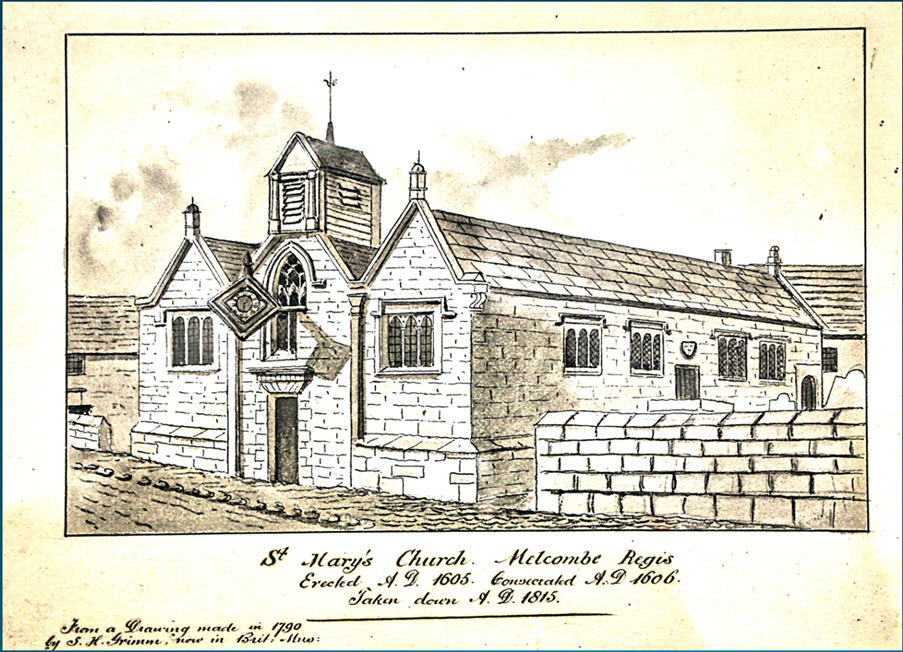
The Oxford Dictionary of National Biography (ODNB) states that, ‘Samuel Mico was either born in London or migrated there’. Samuel was, in fact, born and baptised in Weymouth. Whilst we do not know the actual date of his birth, recent research has revealed that he was baptised in the parish church of St Mary in Melcombe Regis on 22nd March 1608. His father was Richard, a merchant. His mother was named Elizabeth (nee Allen). Samuel’s confirmed brothers and sisters included Elizabeth, John and Hester.
It is possible that Richard Mico (Samuel’s father) died in Melcombe Regis in 1616.
Baptism Record of Sir Samuel Mico

St Mary's Church 1606
If indeed his father died when Samuel was just nine years old it seems likely that he was ‘taken under somebody’s wing’ perhaps someone who was a merchant like his father, or possibly his uncles in Croscombe or Taunton. Samuel’s mother, Elizabeth is mentioned as living in a property in Melcombe Regis near the quayside in a survey of rents on 6th August 1617. There is no mention of her husband Richard Mico. It is believed the property used to belong to ‘Richard Allin’.
“In the east side of Maiden Street Richard Allin, now Elizabeth Mico his tenement bounded in the south on the key in the north on Mr Churchill’s garden in the east on a void plot of Samuel Allin’s and in the west part on a tenement of the said Mico and part on the towne key. Paid 6d Also one part of grownd bounded in the south of the towns key in the north on John Churchills cellar in the east on the said Elizabeth Mico. Paid 6d”
Presently we do not know where Samuel received his formal education or indeed his apprenticeship. There is a possibility it could have been conducted abroad.
Samuel Mico married Elizabeth Andrewes, whose father Henry Andrewes was Alderman of Farringdon Ward Within from 1632 until 1638 and sheriff from 1632 until 1633. In London he lived in the parish of St Andrew Undershaft and he also owned the George Tavern on the quayside in Weymouth. Sadly, Samuel’s personal life was beset with strife; all of his five children died before reaching the age of 5 and his wife, Elizabeth, died at the age of 22. Samuel later remarried Jane Robinson from Cheshunt in Hertfordshire. She later became known as Dame Jane Mico.
The George Inn

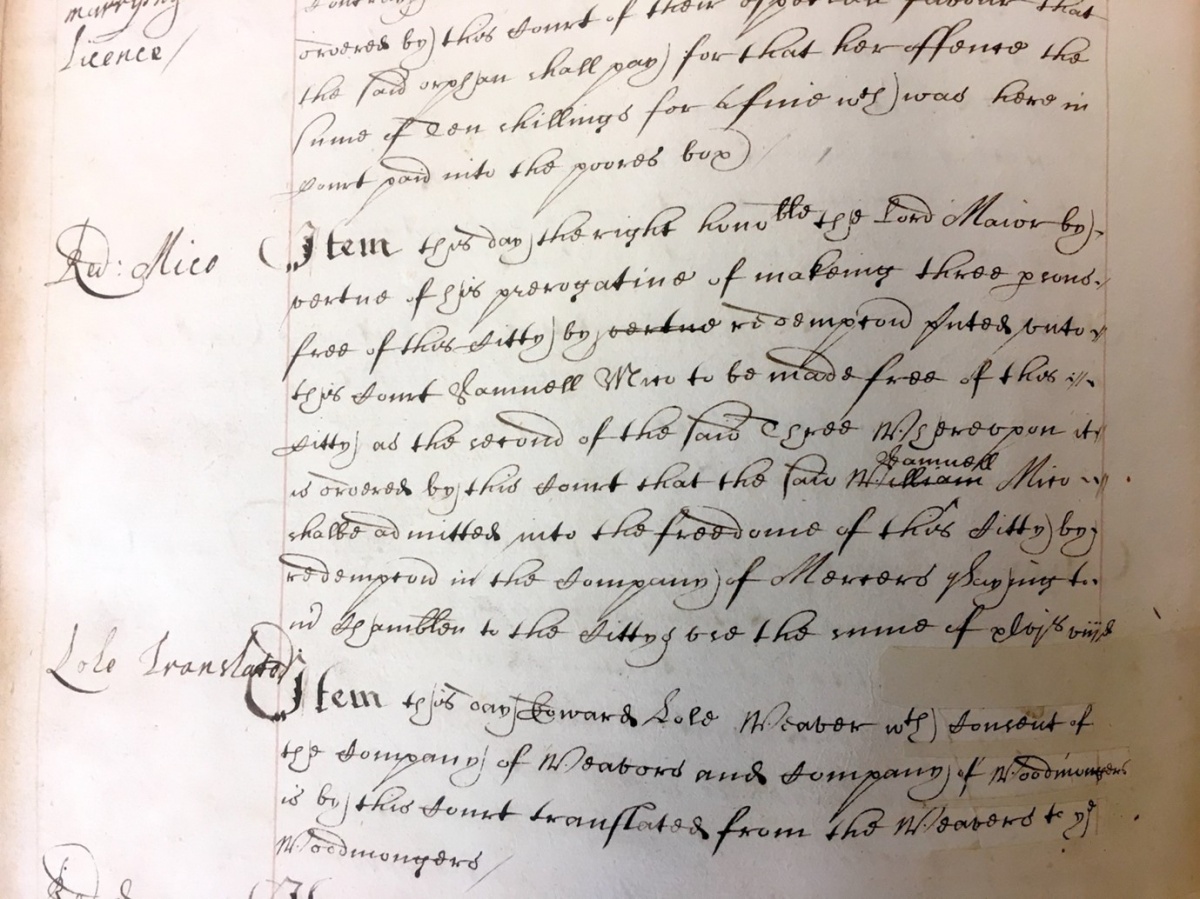
He was admitted to the Freedom of the City of London on 26th March 1633 in the Mercers’ Company: an extract of the records reads as follows:
“Item this day the right honourable the Lord Maior by vertue of his prerogative of making three persons free of this Citty by redempcion presented unto this Court Samuell Mico to be made free of this Citty as the second of the said Three Whereupon it is ordered by this Court that the said Samuell Mico shallbe admitted into the freedome of this Citty by redempcion in the Company of Mercers paying to Mr Chamberlen to the Cittys use the sume of xlvis. Viiid”
Mercers Minute Book
Samuel was a Member of the Court of Assistants of the Levant Company from 1647- 1649. He traded in the Middle and Far East as a member of the Levant and East India Companies, importing spices, currants, wine and silk.
An extract from Samuel Pepys Diary for the 19 February 1664 confirms Mico’s involvement with the East India Company. This it is believed relates to the seizure of several fully laden cargo ships by the Dutch East India Company. It is believed that the large sum mentioned in connection with Mico represents compensation to owners and those with interests in the cargoes of the seized ships.
19th February 1664: Up in good order in my head again and shaved myself, and then to the office, whither Mr. Cutler came, and walked and talked with me a great while; and then to the ‘Change together; and it being early, did tell me several excellent examples of men raised upon the ‘Change by their great diligence and saving; as also his owne fortune, and how credit grew upon him; that when he was not really worth L1100, he had credit for L100,000 of Sir W. Rider how he rose; and others. By and by joyned with us Sir John Bankes; who told us several passages of the East India Company; and how in his very case, when there was due to him and Alderman Mico L64,000 from the Dutch for injury done to them in the East Indys, Oliver presently after the peace, they delaying to pay them the money, sent them word, that if they did not pay them by such a day, he would grant letters of mark to those merchants against them; by which they were so fearful of him, they did presently pay the money every farthing.”
The ships involved are believed to be the English ships Postilion, Fredrick, Francis, John and the Bantam Frigate. The seizure is recorded in the Court Minutes of the East India Company on 2nd July 1658. On 6th July 1658 Samuel Mico (and others) petitioned the Council of State to take action of the seizure of these vessels. As a result, the Secretary to the Council was ordered “to write to His Highness’s Agent in the Low Countries to represent the case to the Lords the States- General and require from them justice and satisfaction.”
On the 6th December 1653 Mico was elected as the Alderman for the Ward of Farringdon Without and was sworn into this role on 8th December 1653. He was discharged from this office on 13th May 1656 on payment of a fine of £700.
Samuel was a merchant of some standing; court minutes of the time show that he paid £1,260.3s.6d on the 1st June 1659 for 1075 parts of long cloth. On 10th October 1660 he bought quantities of spices and cloths at the Company sale at a cost of well over £1,000. These were considerable sums of money at the time.
Samuel was master of the Mercers’ Company in 1655. He twice stood for Parliament representing Weymouth in 1660, but was not elected.
He was Knighted Sir Samuel Mico on 18th March 1665. Unlike most people who are knighted there was no official record as to why Sir Samuel Mico was knighted. However, in a letter to the Sir Samuel Mico Trust dated 29 March 1882 from Sir Albert W Woods, Garter King of Arms at the College of Arms he suggests “that he was knighted in consideration of a liberal subscription to King Charles II’s loan of £100,000 which was made to him about 1664”. It was recorded in history that Charles II had financial difficulties and it would therefore seem that Sir Samuel Mico was knighted for assisting the King pay his debts.
Sir Samuel’s will was written on 21st September 1665 at the height of the plague. He died on 23rd May 1666 and was buried in the crypt of the Mercers’ Chapel in London. On 11th July 1666 the court minutes of the East India Company granted “Sir Samuel Micos Lady” permission to use the House for one day to sell goods left to her by Samuel.
In his will he left most of his estate to his widow (Lady Jane Mico) and his nephew, also Samuel. He left the George Tavern and a sum of £500 to the town of Weymouth for the preaching of an annual sermon in the parish church, for the binding out of three poor children apprentices and for the relief of ten poor decayed seamen of the town, aged 60 and upwards. He left a similar sum of money to the Mercers’ Company to provide loans for young men to set them up in business.
Samuel’s impact upon Restoration London and beyond was powerful and far – reaching. On 9th January 1651 an Alderman Pennington complained to Oliver Cromwell and the Council of State on Samuel’s behalf, stating, “That he employeth some Thousands of people of this commonwealth in making of manufactures of wool, to be transported beyond the seas.”
Writing found on the back of an old parchment in the Charity’s archives reads:
“These writings concerning the gift of the George Taberna for ye binding out of three poor children yearly apprenticed out of the profit of the George aforesaid were put into the Gowne chest at the Full Hall of the Maisonette of Sir Roger Cathance, Knight Held Serptember 1668”.
It is believed that the pensions and apprenticeships did not start immediately because for some years the burgesses of the borough used the money to repair damage sustained during the Civil War.
The original George Inn, which was built in 1550, was a picturesque two – storeyed stone building with large residential accommodation running back into Helen Lane.
The Original George Inn

Outside were some ancient stone steps to the water. Known as the George “Stairs”. The quay then was narrow, giving little more space than required for carts to pass. The original George was demolished around 1880 and a replacement built.
Lady Jane Mico died in 1670 and was buried alongside her husband in the Mercers’ Hall. In her will she promised a substantial amount of money to her nephew, Samuel Mico, provided he married her niece. He didn’t. However, some almshouses were built in Stepney, bearing her name but a lot of the money lay unused and contested for the next 200 years until the local anti – slavery champion, Thomas Fowell Buxton, suggested the unused funds be put to effective use in the West Indies through education. Many schools were established bearing Mico’s name. Today there remains the important Mico Teacher – Training College in Kingston, Jamaica. It acknowledges that its all – important origins in 1836 were largely due to Lady Mico.
Finally, we now accept that Samuel Mico was indeed born and bred as a Weymouth boy. He did, eventually, migrate to London, where he made his fortune, but remained true at heart, a Weymouthian. He remained loyal to the town through his gracious gifts and benevolence, so much so that nearly 360 years later, he still provides support to many local people, young and old.
Links:

Mico Coat of Arms
 Mico’s coat of arms, which are vested in the care of trust, were originally described as “or three black- a- moors’ heads sable bound with a fillet argent and wearing earrings argent: two in chief one in point. Crest a dexter arm issuing from a cloud both proper – the hand holding a dagger argent with handle or transfixing a black- a- moor’s head sable from which fall drops of blood gules”.
The coat of arms used today, which have been modified to be less gruesome are affixed to the north balcony on the inside of St Mary’s church, St Thomas Street, Weymouth and are easily recognised by the trademark Black Moors heads.
Those seeing the Coat of Arms for the first time often think that Mico was involved in the slave trade, but the three black heads depict the Mediterranean Moors Pirates also known as the Barbary Pirates that operated in the Levant where Mico and others traded. It is thought that the ‘Moors’ heads were on his coat of arms as recognition he fought the Moors and protected the trading routes.
The Trust Today
Almost 360 years after Mico’s death the trust continues to support apprentices and others on educational courses who have not reached 25 years of age, it also pays a small pension to “poor decayed” seamen. The trust, due to good management, gives scholarships or grants to around 100 young people a year, Mico originally envisaged supporting 3 apprentice boys.
Annual Mico Service
Each year on the Friday before Palm Sunday at 1100 hrs the trustees, descendants of Sir Samuel, seamen and the young beneficiaries of the trust continue the tradition of gathering in the parish church of Weymouth (St Mary’s), as set down in Mico’s will. A laurel wreath is placed on Sir Samuel Mico’s coat of arms.

Sir Samuel Mico decreed in his will that those gathered should hear a sermon by a “Good Divine” (a priest) and afterwards should retire to a local hostelry where all can partake in refreshments. Mico also stated the apprentices (beneficiaries) should give the trustees a report on their progress at this annual gathering.

After the service the trustees, led by the Mayor and ceremonial mace – bearers of the borough, are joined by the beneficiaries and others who attended the service, to proceed through the streets of Weymouth to The George Inn on the quay (Mico’s Inn), where all partake in wine, lemonade and hot cross buns as set down by Mico.
for more information on local history go to the Weymouth Museum website http://www.weymouthmuseum.org.uk/